
A rental kitchen does not always come with enough cabinets, drawers, or countertop space. Adding storage can be challenging when your lease restricts drilling holes, installing permanent shelves, or modifying existing cabinets.
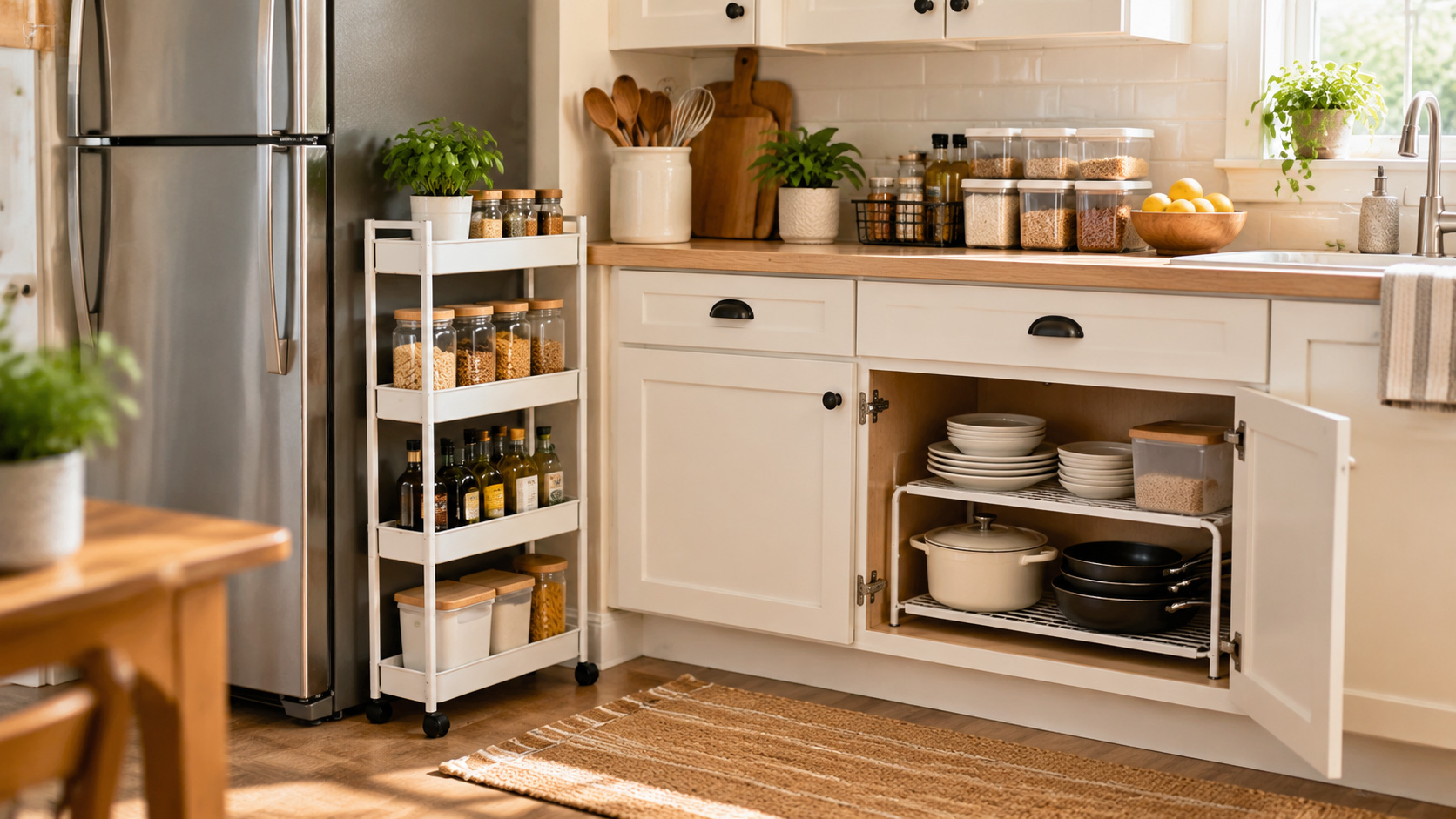
Fortunately, you can create more functional storage without using a drill or making permanent changes to your kitchen. Freestanding rolling carts, cabinet shelf risers, adjustable drawer dividers, over-the-door organizers, and carefully selected removable accessories can help you make better use of the space you already have.
The key is choosing storage that fits your kitchen layout, stays stable during everyday use, and can be removed or taken with you when you move.
Here are nine practical renter-friendly kitchen storage solutions to consider, along with tips for choosing the right organizers and avoiding unnecessary damage to your rental property.
1. Add a Freestanding Rolling Storage Cart
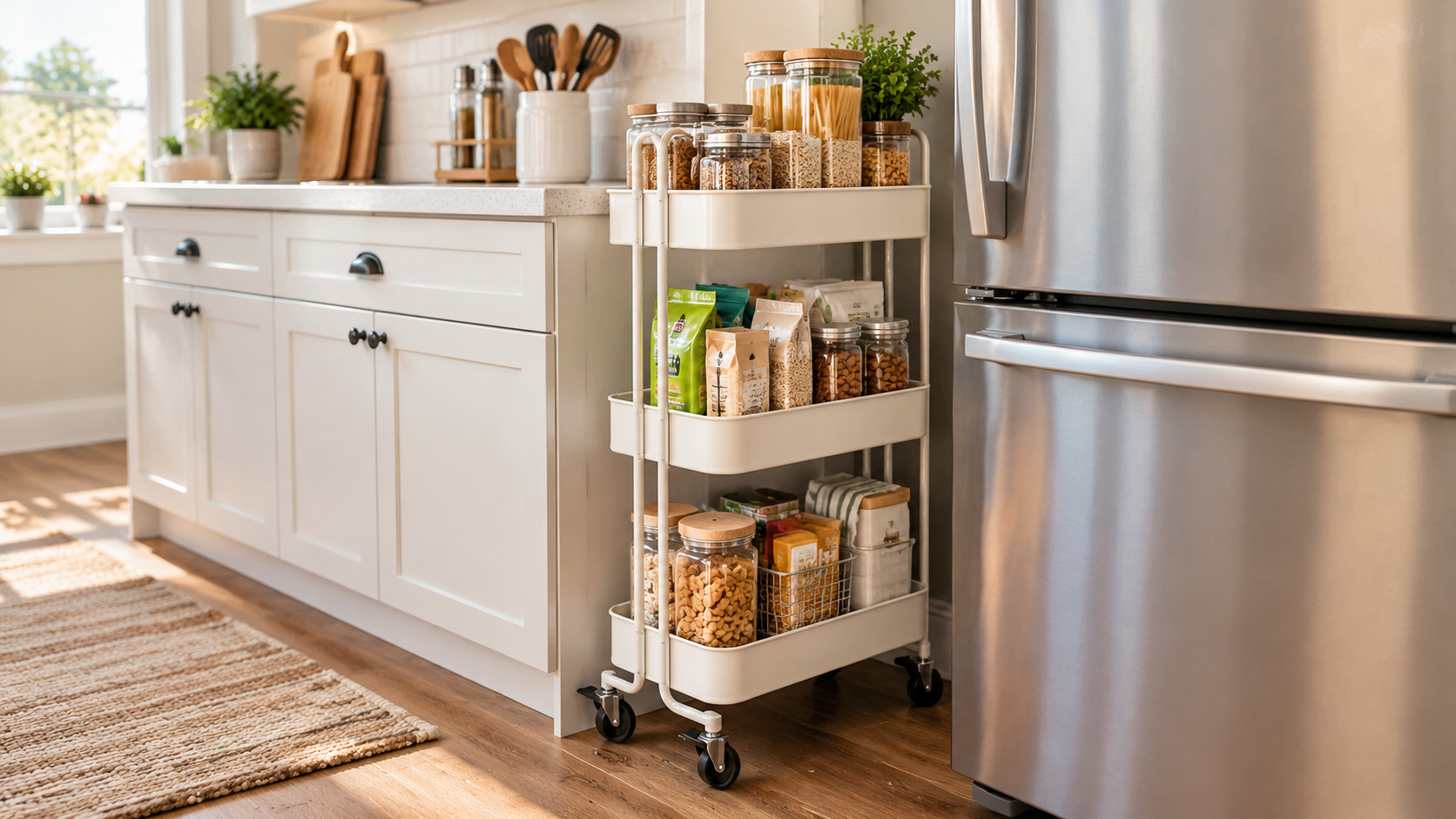
A rolling storage cart is one of the most flexible ways to add kitchen storage without drilling. It provides additional shelves and can fit into narrow spaces that would otherwise remain unused.
Look for a slim three-tier or four-tier cart that can slide beside your refrigerator, between cabinets, or into an unused kitchen corner.
You can organize it by function:
- Top tier: Frequently used cooking ingredients or small kitchen accessories.
- Middle tier: Snacks, food containers, or everyday supplies.
- Bottom tier: Larger packages, reusable shopping bags, or heavier items within the cart’s rated capacity.
A rolling cart can also serve as a portable pantry if your rental kitchen does not have a dedicated food-storage cabinet.
Before purchasing one, measure the available floor space and check the cart’s overall dimensions. Pay attention to its width, depth, and height, especially if it needs to fit beneath an existing counter.
Choose a model with locking casters when you need it to remain stationary during use. Lock the wheels before placing or removing items, and avoid using an unstable cart as a cutting surface.
Best for: Small rental kitchens, unused gaps, and apartments without enough pantry storage.
2. Use Freestanding Shelf Risers Inside Cabinets
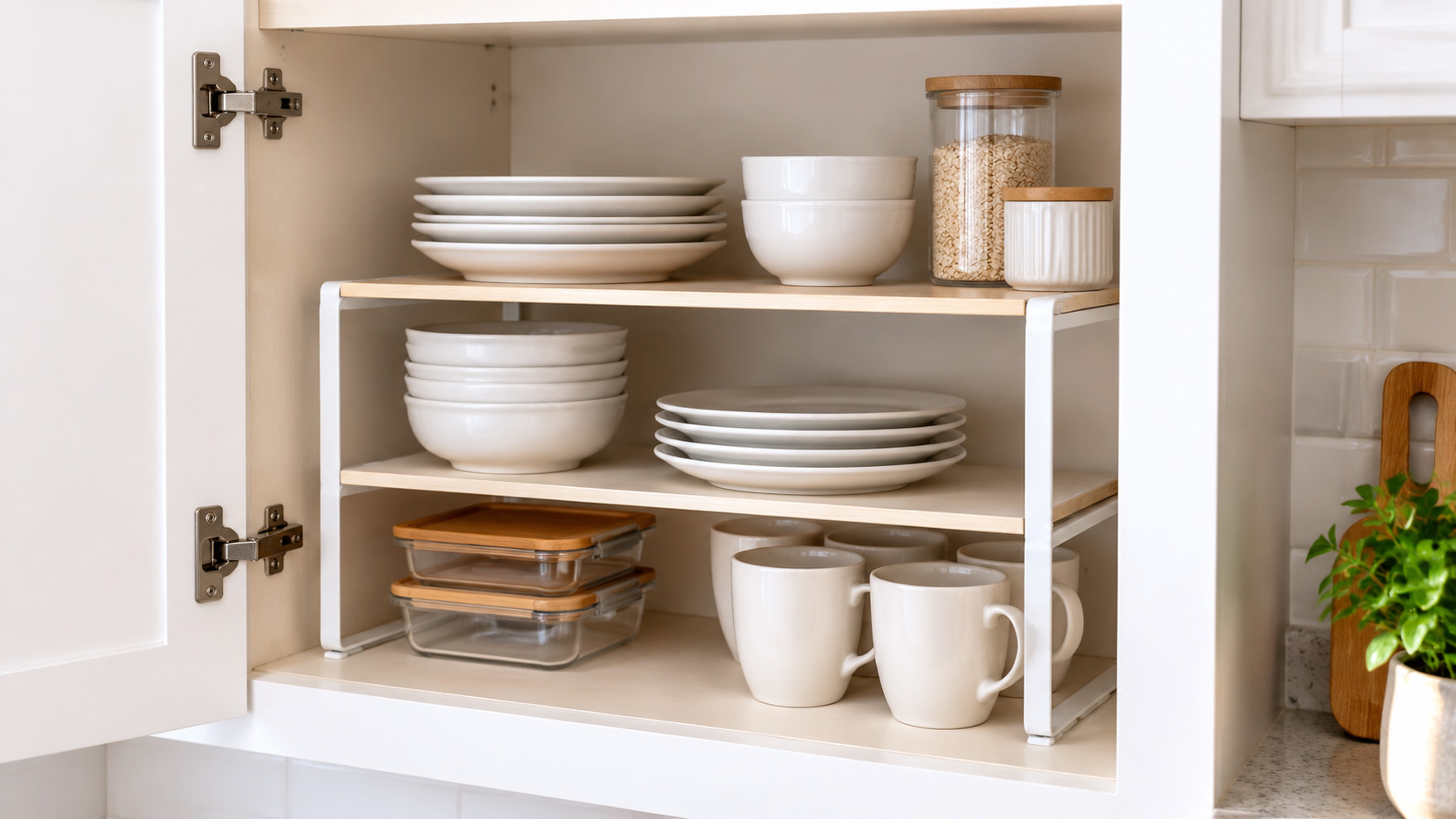
Cabinet shelf risers help you use vertical space that would otherwise remain empty.
Many rental kitchens have cabinets with one large shelf and considerable clearance above stored plates, bowls, or glasses. Instead of stacking everything on top of each other, a freestanding riser creates a second storage level.
You can use shelf risers to organize:
- Plates and shallow bowls.
- Coffee mugs and drinking glasses.
- Small food containers.
- Spice jars and seasoning packets.
- Lightweight kitchen accessories.
Choose a riser that fits the cabinet’s interior width and depth. Make sure its legs sit flat on the shelf and that it does not interfere with cabinet doors or nearby plumbing.
For heavier dishes, select a product with an appropriate load rating and a stable base. Avoid stacking fragile items too high.
Because freestanding shelf risers simply sit on an existing surface, they are easy to remove, reposition, and take to another home.
Best for: Renters who have cabinet space but struggle with inefficient vertical storage.
3. Organize Drawers With Adjustable Dividers
Kitchen drawers often become cluttered because utensils, cooking tools, and miscellaneous accessories are stored together.
Adjustable drawer dividers provide a simple way to separate these items without installing permanent hardware.
There are two common options:
- Drop-in dividers: Removable trays or compartments that sit directly inside a drawer.
- Expandable dividers: Adjustable pieces that fit between the drawer’s interior walls.
Use separate sections for cooking utensils, measuring spoons, cutlery, kitchen gadgets, and small accessories.
Before purchasing an expandable organizer, measure the drawer’s usable interior width, depth, and height. Do not rely on the outside dimensions of the drawer because the interior may be narrower.
If you choose a spring-loaded divider, check that its ends have suitable protective pads and that the pressure does not damage the drawer finish.
For renters, removable organizers are generally more flexible than screw-mounted drawer systems because they can be taken out without changing the cabinet.
Best for: Small drawers, crowded utensil storage, and kitchens without built-in drawer organizers.
4. Make Use of Over-the-Cabinet-Door Organizers
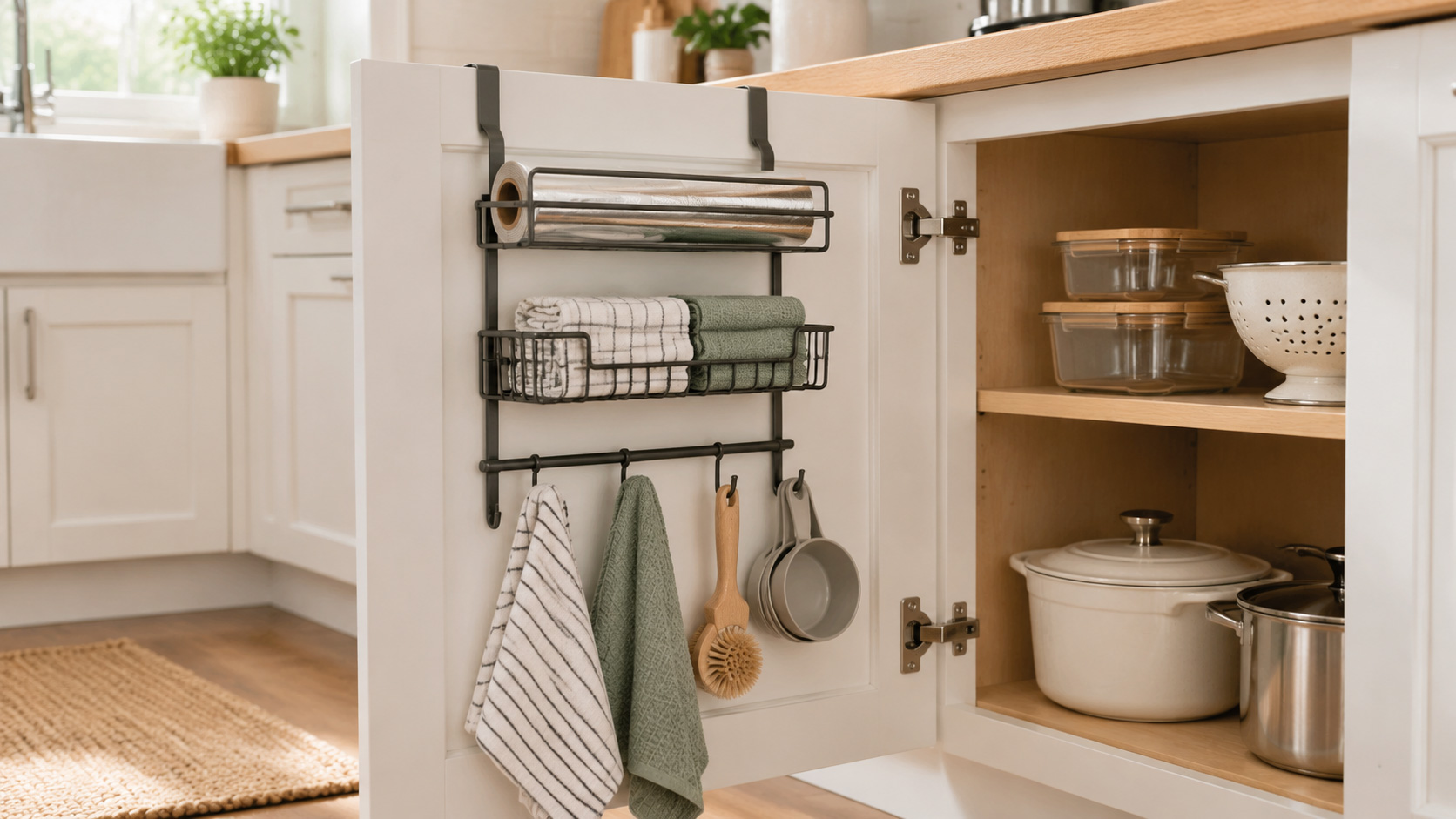
The inside of a kitchen cabinet door can provide additional storage without requiring screws or wall-mounted racks.
Over-the-door organizers typically use metal or plastic brackets that hook over the top edge of a cabinet door.
They can be useful for storing:
- Dishwashing gloves.
- Lightweight cleaning cloths.
- Small food-storage accessories.
- Foil and plastic wrap.
- Lightweight kitchen tools.
Some designs include narrow baskets, hooks, or small shelves.
Before purchasing one, measure the thickness of your cabinet door and check the product’s required clearance. The bracket must fit without preventing the door from closing properly.
Also inspect the position of the hinges, nearby drawers, and adjacent cabinet doors. An organizer that extends too far may interfere with normal kitchen use.
To reduce the risk of scratching, choose a model with appropriate protective padding where the manufacturer provides it. Avoid overloading the rack or hanging heavy items from the door.
Best for: Cabinets with unused interior door space and renters who need extra storage for small accessories.
5. Use Tension Rods to Create Flexible Cabinet Storage
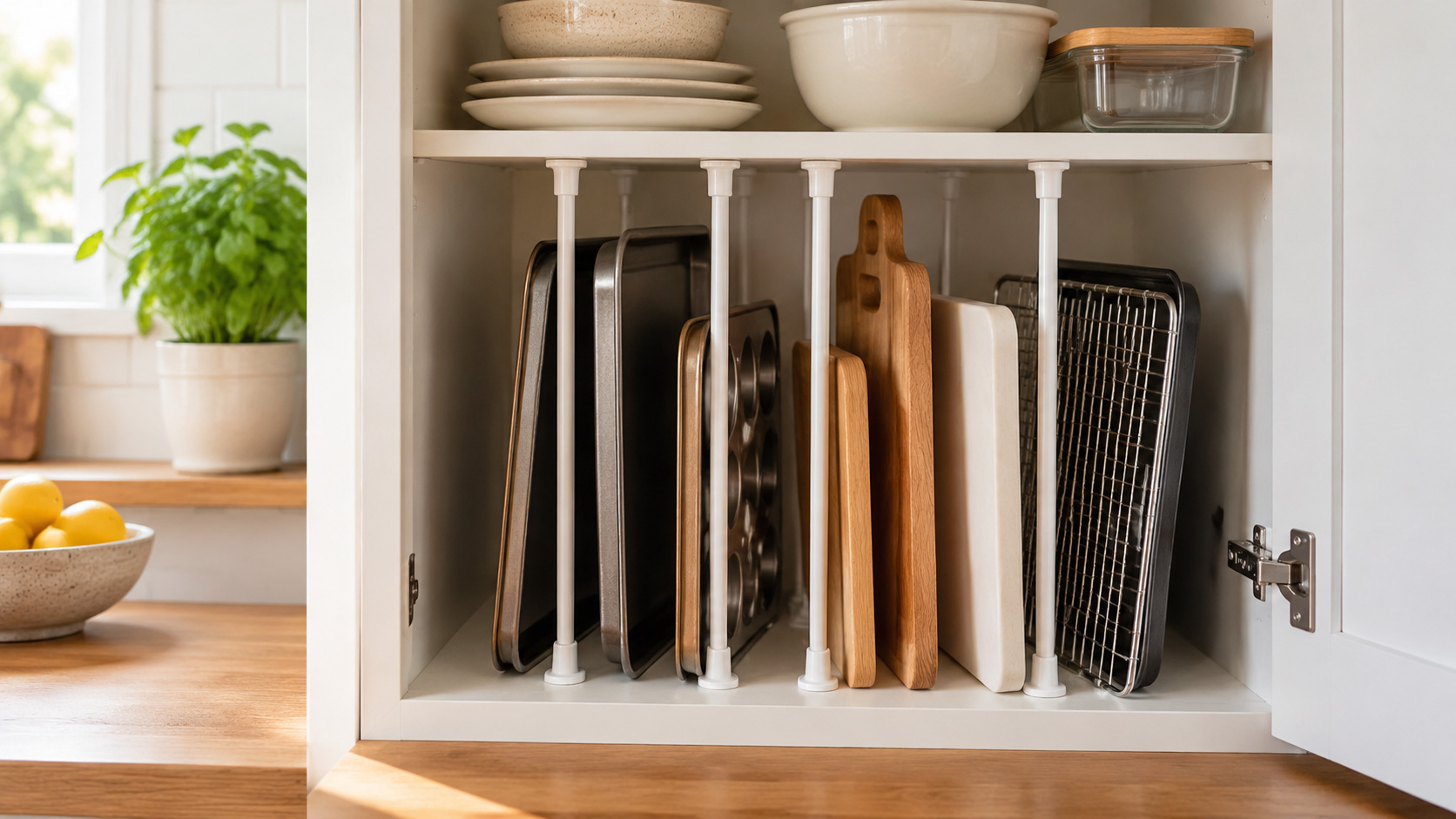
Tension rods can help organize awkward cabinet interiors without drilling holes.
These adjustable rods fit between two opposing surfaces using pressure rather than permanent fasteners. Depending on the design, they can create simple dividers or additional hanging space.
One practical application is organizing baking sheets, cutting boards, and lightweight trays vertically inside a cabinet.
Instead of stacking these items horizontally, position suitable dividers or tension-supported separators so each item has its own space.
You can also use a properly sized tension rod inside a cabinet to separate small storage zones.
When selecting a tension rod, consider:
- The exact distance between the two mounting surfaces.
- The rod’s stated weight capacity.
- Whether the contact ends suit the cabinet finish.
- Whether the rod can remain securely positioned during normal use.
Install it according to the manufacturer’s instructions and test its stability before loading it.
Do not assume that every tension rod can support heavy cookware or hanging storage. Excessive pressure may also leave marks on weak or delicate cabinet finishes.
Best for: Baking sheets, cutting boards, lightweight dividers, and cabinets with unused vertical space.
6. Use Magnetic Organizers on Your Refrigerator
If your refrigerator has a compatible magnetic surface, its side panel may offer another convenient storage area.
Magnetic organizers can hold lightweight kitchen accessories without drilling or attaching anything to the wall.
Possible uses include:
- Small spice containers.
- Lightweight storage baskets.
- Kitchen notes and shopping lists.
- Magnetic hooks for lightweight accessories.
Before buying a magnetic organizer, test the refrigerator surface with a magnet. Not every refrigerator finish provides a suitable magnetic attachment point.
Make sure the organizer is securely attached before adding anything to it. Follow its weight rating and avoid placing heavy glass containers in a position where they could fall.
Keep the contact surfaces clean to reduce the risk of trapped dirt scratching the refrigerator finish.
Magnetic spice storage can be particularly useful when cabinet space is limited. For more specific ideas, see our guide to small kitchen spice storage hacks.
Best for: Renters with compatible refrigerator surfaces who need additional space for lightweight kitchen accessories.
7. Create a Portable Pantry With Stackable Storage Bins
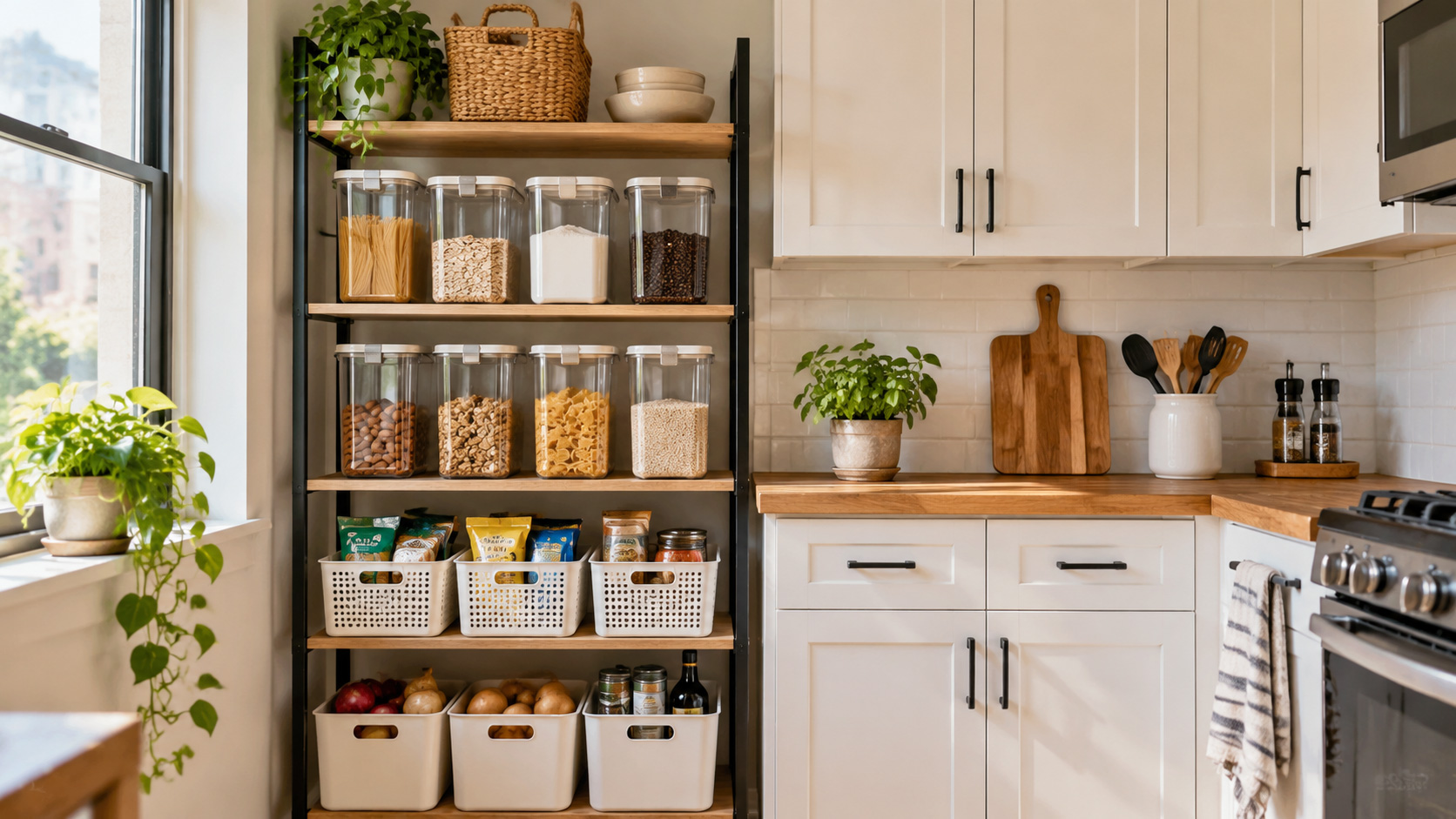
If your rental kitchen does not have a pantry, stackable storage bins can help create a simple alternative.
Instead of leaving food packages scattered across countertops and cabinets, group similar items into separate containers.
For example:
Storage bin Suggested contents Everyday essentials Rice, pasta, and frequently used dry ingredients Breakfast supplies Cereal, oatmeal, and breakfast snacks Baking ingredients Flour, sugar, and baking accessories Snack storage Individually packaged snacks and small food items Backup supplies Unopened food packages and replacement items
Choose bins that fit the available cabinet, shelf, or countertop dimensions.
Clear containers make it easier to identify contents, while handled baskets are useful when you need to move several items at once.
For food storage, use containers appropriate for the specific food and keep ingredients in their original packaging when required for labeling, allergen information, or expiration details.
Avoid stacking heavy containers above shoulder height or placing unstable stacks where they can fall.
The biggest advantage is flexibility. You can rearrange the containers as your storage needs change and pack them easily when moving.
Best for: Rental kitchens without a pantry, limited cabinet space, and households that need better organization for dry goods.
8. Add a Freestanding Countertop Organizer
When cabinet space is limited, a freestanding countertop organizer can create another useful storage level.
These organizers are available in different configurations, including two-tier shelves, small racks, and compact countertop storage units.
They can help organize:
- Coffee cups and tea supplies.
- Frequently used seasonings.
- Small food containers.
- Cooking accessories.
- Lightweight kitchen essentials.
A two-tier countertop shelf is particularly useful because it uses vertical space rather than spreading everything across the work surface.
However, avoid filling every available countertop area with organizers. You still need enough clear space for food preparation and everyday kitchen activities.
Keep organizers away from direct heat, open flames, and areas exposed to frequent water splashes. Do not place them where they obstruct appliance ventilation or access to electrical outlets.
Choose a stable design with a suitable base, especially if you plan to store glass containers or frequently used items.
Best for: Renters who have limited cabinet storage but still have some available countertop space.
9. Use Removable Adhesive Hooks and Accessories Carefully
Removable adhesive hooks and small organizers can provide additional storage without drilling into walls or cabinets.
They are useful for lightweight accessories such as:
- Dish towels.
- Lightweight oven mitts.
- Small cleaning brushes.
- Measuring spoons.
- Lightweight kitchen accessories.
However, adhesive products require more careful selection than freestanding organizers.
Not every adhesive product is suitable for every surface, and removable does not automatically mean damage-free.
According to 3M’s official Command product guidance, these products work best on clean, dry, smooth surfaces. Their weight limits vary by product, and painted walls must be fully cured for at least seven days before certain Command products are applied.
The manufacturer also advises against using applicable products on heavily textured surfaces, wallpaper, brick, and rough concrete. Always check the specific product packaging because different adhesive products have different requirements.
For a rental kitchen, follow these precautions:
- Check your lease and confirm that removable adhesive products are permitted.
- Inspect the surface for weak, peeling, or damaged paint.
- Confirm that the product is designed for the surface and environment.
- Check the exact weight rating before hanging anything.
- Follow the manufacturer’s cleaning, application, waiting, and removal instructions.
- Avoid areas exposed to frequent water splashes, steam, or unsuitable temperatures.
For Command products with removable pull tabs, 3M instructs users to pull the tab slowly and straight down rather than pulling the hook outward. Improper removal or weak paint can still cause damage.
Adhesive accessories should therefore be a secondary option, not the first choice for adding substantial kitchen storage.
Best for: Lightweight accessories on suitable surfaces when the lease and product instructions permit their use.
How to Choose the Right No-Drill Kitchen Storage
Not every storage solution works equally well in every rental kitchen.
The best option depends on the type of space available, the items you want to store, and how much flexibility you need.
Use this comparison as a starting point:
Storage solution Best application Installation Main consideration Rolling cart Unused floor gaps and portable pantry storage Freestanding Floor space and stability Shelf riser Existing cabinets Freestanding Cabinet height and load capacity Drawer dividers Utensils and kitchen tools Removable Interior drawer dimensions Over-door organizer Cabinet door storage Hook-on Door thickness and hinge clearance Tension rod Cabinet dividers Pressure-mounted Secure fit and surface condition Magnetic organizer Refrigerator side panel Magnetic Surface compatibility and weight Stackable bins Food and household supplies Freestanding Stack stability and dimensions Countertop organizer Frequently used kitchen items Freestanding Available work surface Adhesive hooks Lightweight accessories Adhesive Surface compatibility and removal risk
If you are unsure where to begin, start with freestanding products. They generally offer greater flexibility because they do not depend on the condition of your walls, cabinet finishes, or adhesive surfaces.
Check Your Rental Agreement Before Installing Anything
No-drill storage can reduce the need for permanent modifications, but it does not automatically mean every product is permitted by your rental agreement.
Review your lease before installing adhesive hooks, pressure-mounted systems, or accessories that attach to existing property surfaces.
For example, the Minnesota Attorney General’s tenant handbook explains that renters ordinarily need landlord permission for permanent fixtures and other property alterations. This is a state-specific example, not a nationwide rule, so check the requirements applicable to your own rental property.
You can also contact your landlord or property manager if you are uncertain whether a particular organizer is allowed.
When possible, prioritize storage that:
- Sits independently on the floor or countertop.
- Fits inside existing cabinets and drawers.
- Can be removed without tools.
- Does not require permanent fasteners.
- Does not interfere with appliances, plumbing, or ventilation.
Taking these precautions can make it easier to restore the kitchen to its original condition when your lease ends.
Common Mistakes to Avoid
Even simple no-drill storage solutions can create problems when they are poorly selected or installed.
Watch out for these mistakes:
Buying organizers before measuring. A product that looks compact online may not fit your cabinet, drawer, or available floor space.
Overloading removable organizers. Adhesive hooks, tension rods, and cabinet-door racks all have limitations. Stay within the manufacturer’s specifications.
Using adhesive products on unsuitable surfaces. Weak paint, textured walls, wallpaper, and unsuitable finishes can increase the risk of poor adhesion or surface damage.
Ignoring cabinet-door clearance. Over-door organizers can prevent doors from closing or interfere with hinges.
Blocking important kitchen areas. Avoid placing organizers where they obstruct electrical outlets, appliance ventilation, plumbing access, or food-preparation space.
Buying too many storage products at once. Start with the areas causing the most inconvenience. Add more organizers only when you understand what the kitchen actually needs.
A Simple Weekend Plan for Organizing Your Rental Kitchen
You do not need to reorganize the entire kitchen in one day.
A gradual approach helps you avoid purchasing organizers that do not fit your space.
Step 1: Identify the problem areas.
Choose the most frustrating area, such as an overcrowded cabinet, messy drawer, or countertop with too many appliances.
Step 2: Remove unnecessary items.
Take everything out of that area. Remove duplicates, empty packaging, and kitchen accessories you no longer use.
Step 3: Measure the available space.
Record the usable width, depth, and height of the cabinet, drawer, countertop, or floor gap.
Step 4: Choose one suitable organizer.
Start with a simple solution such as a shelf riser, drawer divider, or rolling cart.
Step 5: Test the arrangement.
Use the organizer for several days. Check whether items remain accessible and whether the arrangement interferes with everyday kitchen activities.
Step 6: Expand only when necessary.
Once the first area works well, move to the next problem area.
This approach keeps the organization process manageable and reduces unnecessary purchases.
Frequently Asked Questions
How can I add kitchen storage without drilling holes?
Use freestanding rolling carts, cabinet shelf risers, adjustable drawer dividers, stackable bins, and countertop organizers. Over-the-door racks and tension rods can also work when their dimensions and installation requirements match your kitchen.
What is the best renter-friendly kitchen storage solution?
Freestanding storage is a practical starting point because it does not require permanent installation. Rolling carts are useful for unused floor space, while shelf risers and drawer dividers help organize existing cabinets.
The best choice depends on your available space and storage needs.
Can adhesive hooks damage rental walls?
Yes. Although some adhesive products are designed for clean removal, they can still damage weak, uncured, peeling, or unsuitable surfaces. Follow the manufacturer’s instructions and check your lease before using them.
How do I organize a small rental kitchen with no pantry?
Use stackable storage bins, a slim rolling cart, and freestanding cabinet organizers to create separate storage zones. Group food by category and keep frequently used ingredients within easy reach.
Are tension rods safe for kitchen cabinets?
They can be useful for lightweight organization when correctly sized and installed according to the manufacturer’s instructions. However, their stability and suitability depend on the rod design, mounting surfaces, and intended load. Avoid using them to support heavy items unless specifically rated for that purpose.
Final Thoughts
Adding kitchen storage to a rental property does not require drilling holes or installing permanent fixtures. With the right combination of rolling carts, shelf risers, drawer dividers, removable organizers, and stackable bins, you can make a limited kitchen more functional.
Start by measuring your available space and identifying the areas that need the most improvement. Prioritize freestanding storage, check product specifications, and use adhesive or tension-mounted accessories only when the surfaces and rental rules allow them.
A flexible storage system should make everyday cooking and organization easier while remaining simple to adjust, remove, and take with you when it is time to move.

Royan Abdillah is a home improvement enthusiast and interior design consultant with over 9 years of experience in the industry. Passionate about blending aesthetics with functionality, Royan Abdillah specializes in unique DIY furniture and pet-friendly home solutions. Through this blog, Royan Abdillah aims to help homeowners create beautiful, personalized spaces on a budget.