
Want to add curtains to your home without putting holes in the walls? Whether you live in a rental apartment, a dorm, or simply want to avoid drilling into a finished wall, several no-drill curtain hanging options can help you create a comfortable and attractive space.

Tension rods, adhesive curtain rod holders, magnetic rods, and other removable mounting systems make curtain installation easier without traditional screws or wall anchors. However, the right solution depends on more than convenience. Your curtain weight, window design, mounting surface, and everyday usage all affect which method is most suitable.
It is also important to understand that no-drill does not automatically mean damage-free. Adhesive products, for example, have specific surface requirements and weight limits, while pressure-mounted rods need suitable support points.
In this guide, you will discover five practical ways to hang curtains without drilling, how to choose the right system, and which installation mistakes to avoid.
Can You Hang Curtains Without Drilling?
Yes, you can hang curtains without drilling by using tension rods, adhesive curtain rod holders, magnetic curtain rods, clamp-on brackets, and floor-to-ceiling tension systems. The best option depends on your window configuration, curtain weight, and the surface supporting the hardware.
For a small recessed window, a tension rod may be the simplest choice. For a suitable smooth wall, an adhesive curtain rod holder can provide a more traditional appearance. Magnetic rods are useful when a compatible metal surface is available, while floor-to-ceiling tension systems can help divide larger spaces.
The key is to match the mounting method to your window rather than choosing hardware based solely on how easy it is to install.
5 No-Drill Curtain Hanging Options
1. Tension and Twist-Fit Curtain Rods

Tension rods are among the simplest ways to hang curtains without drilling. They fit between two opposing surfaces and remain in place through pressure rather than screws or wall anchors.
Spring-loaded and twist-fit models are particularly useful for recessed windows, where the rod can sit inside the opening. They are practical for lightweight curtains, small kitchen windows, bathroom windows, and temporary installations.
Their main advantage is easy installation and removal. You can generally adjust or remove the rod without leaving screw holes in the wall.
However, tension rods need suitable support points. An uneven opening, an incorrectly sized rod, or an unsuitable surface can cause the rod to slip. The amount of weight a rod can support also varies by model.
Best for: Recessed windows, lightweight curtains, cafe curtains, and temporary installations.
Before buying: Check the adjustable width, installation requirements, and manufacturer’s stated weight capacity.
2. Adhesive Curtain Rod Holders
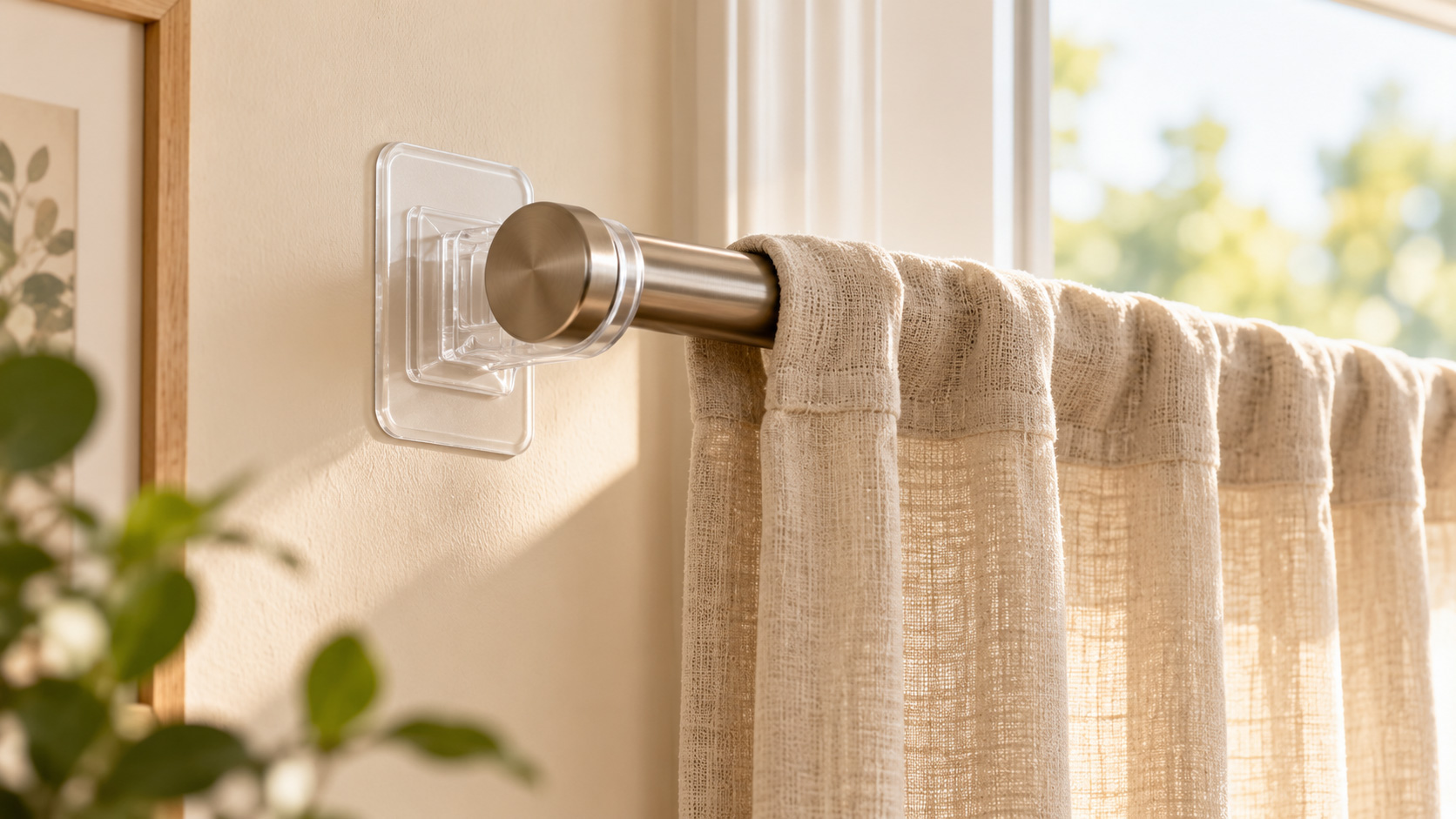
Adhesive curtain rod holders attach to a wall using an adhesive mounting system rather than screws. They are useful when you want the curtain rod positioned above a window instead of inside the window recess.
These holders can provide a conventional curtain appearance while avoiding drilled holes. Some products are specifically designed for rental homes and temporary decorating.
For example, 3M Command Curtain Rod Hooks are designed for no-drill installation. The manufacturer provides specific instructions about compatible surfaces, surface preparation, rod dimensions, and removal.
Adhesive holders are not suitable for every wall. Some Command curtain rod hook models exclude wallpaper, fabric, textured walls, brick, and rough surfaces. Their weight limits also vary by product, so do not assume that all adhesive hooks can support the same curtain load.
For better results, use a product designed specifically for curtain rods, prepare the surface according to the instructions, and allow the adhesive to set for the required time before hanging the curtains.
Best for: Suitable smooth painted walls, finished wood, tile, glass, and other surfaces explicitly approved for the selected product.
Before buying: Verify surface compatibility, rod diameter, weight capacity, and removal instructions.
3. Magnetic Curtain Rods

Magnetic curtain rods attach to compatible metal surfaces without drilling or adhesive. They can be convenient for metal doors, steel window frames, and other suitable ferromagnetic surfaces.
Their main advantage is straightforward installation. If the surface is compatible, the rod can be positioned without creating holes or applying adhesive to the wall.
The main limitation is material compatibility. Not every metal-looking frame attracts a standard magnet. Aluminum, for example, is not attracted to an ordinary magnet in the same way as steel.
Before purchasing a magnetic rod, test the mounting surface with a magnet or confirm the frame material. You should also check the manufacturer’s weight rating and ensure that the rod is suitable for your curtains.
Magnetic systems can be particularly practical for lightweight panels. For heavy blackout curtains or lined drapes, choose a product explicitly rated for the intended load.
Best for: Compatible steel frames, metal doors, and lightweight curtains.
Before buying: Confirm magnetic compatibility and the product’s weight limit.
4. Over-the-Frame No-Drill Brackets

Over-the-frame brackets provide another option when you want to hang curtains without drilling into the wall. Depending on the design, these brackets clamp over or hook onto a suitable window or door frame and support a curtain rod.
They can be useful when a tension rod will not fit the opening and you prefer not to attach adhesive holders to the wall. Some designs also create a more conventional curtain installation.
However, these products are not universal. Frame thickness, trim shape, available clearance, and the way the window or door opens can affect compatibility. Some brackets may also scratch or mark delicate finishes if they are installed incorrectly.
Choose a genuinely clamp-on or over-frame system that does not require drilling or pins if avoiding holes is your priority. Read the product instructions carefully before installation.
Best for: Compatible window or door frames where a clamp-on mounting system can sit securely.
Before buying: Check frame dimensions, clearance, surface protection, and the hardware’s stated load capacity.
5. Floor-to-Ceiling Tension Systems

Floor-to-ceiling tension systems use a vertical support pole held between the floor and ceiling. Depending on the design, they can support curtains or fabric panels without requiring conventional wall-mounted curtain rods.
This option is particularly useful in studio apartments, rented homes, and open-plan interiors where you want to divide a room temporarily. For example, a curtain can separate a sleeping area from a living space without adding a permanent partition.
These systems are more specialized than standard tension rods, so they are not necessarily the best choice for an ordinary recessed window.
The floor and ceiling must provide suitable support, and the selected system must be rated for the intended curtain or divider. Follow the manufacturer’s installation instructions and avoid using a tension pole where the supporting surfaces cannot safely accommodate it.
Best for: Studio apartments, temporary room dividers, and selected wide openings.
Before buying: Check the system’s height range, support requirements, and load capacity.
How to Choose the Right No-Drill Curtain Solution
The easiest way to select a no-drill curtain system is to evaluate four factors before purchasing the hardware.
1. Check the Curtain Weight

Lightweight sheer curtains place different demands on a mounting system than lined blackout curtains or heavy decorative drapes.
Consider the weight of the complete curtain arrangement, not just the appearance of the fabric. Choose hardware with a stated capacity appropriate for the intended load, and follow the manufacturer’s instructions.
2. Identify the Mounting Surface
Determine whether you are working with a recessed window, smooth painted wall, finished wood, tile, glass, metal, wallpaper, or a textured surface.
This is especially important for adhesive systems, which may be unsuitable for certain finishes. If the surface is not listed as compatible, do not assume the product will hold securely.
3. Measure the Window or Opening
Measure the window width and, where relevant, the depth of the recess. Check the adjustment range of the rod or mounting system before purchasing it.
A tension rod usually needs two opposing surfaces, while adhesive holders may allow the rod to sit above the window. Over-frame brackets require a compatible frame shape and thickness.
4. Consider Everyday Use
A curtain that stays closed most of the day may place different demands on its hardware than one opened and closed repeatedly.
Frequent movement can stress the mounting system. If the curtains will be used regularly, prioritize secure installation, suitable hardware, and a clear weight rating rather than choosing solely for appearance.
Quick Selection Guide
| Your Situation | Suitable Starting Option |
| Small recessed window | Tension rod |
| Lightweight cafe curtains | Tension rod |
| Suitable smooth wall | Adhesive curtain rod holder |
| Compatible metal frame | Magnetic curtain rod |
| Compatible window or door frame | Over-the-frame bracket |
| Studio apartment or room divider | Floor-to-ceiling tension system |
These are starting points rather than universal rules. Always check the specifications and conditions of your particular installation.
How to Hang Curtains Without Drilling

Once you have chosen a suitable system, follow these steps to reduce the risk of installation problems.
- Measure the window. Record the width and depth of the opening before buying hardware.
- Identify the mounting surface. Confirm the material and whether the chosen system is compatible with it.
- Check the curtain weight. Compare the intended load with the manufacturer’s stated capacity.
- Choose the appropriate hardware. Select a tension rod, adhesive holder, magnetic rod, clamp-on bracket, or tension pole according to the installation requirements.
- Prepare the surface. For adhesive products, follow the manufacturer’s cleaning and preparation instructions.
- Install the system. Follow the instructions for the specific product instead of relying on a generic method.
- Hang the curtains. Distribute the fabric evenly and avoid placing more weight on the system than it is designed to support.
- Test the installation gently. Open and close the curtains carefully and check for slipping, movement, or sagging.
For adhesive mounting systems, the manufacturer’s installation and removal instructions should take priority over general advice. See the official Command Curtain Rod Hooks instructions for an example of product-specific guidance.
Common No-Drill Curtain Hanging Mistakes
Even a convenient no-drill system can fail if it is poorly matched to the window or installed incorrectly.
- Choosing hardware that is too weak. Check the product’s stated load capacity instead of judging by appearance.
- Ignoring surface compatibility. Adhesive holders are not suitable for every paint finish, wallpaper, or textured wall.
- Skipping surface preparation. Dust, grease, or residue can affect adhesive performance. Follow the manufacturer’s cleaning instructions.
- Using magnetic rods on incompatible surfaces. Test the frame before relying on magnetic mounting.
- Ignoring the window or frame dimensions. A rod or bracket that does not fit properly may slip or interfere with the window.
- Assuming no-drill means damage-free. Adhesive removal, excessive pressure, or contact with delicate finishes can still cause damage.
The safest approach is to choose hardware designed for your specific installation and follow its instructions from setup to removal.
No-Drill Curtain Ideas for Renters and Small Windows

No-drill curtain systems can be useful in rental apartments because they reduce the need for permanent modifications. The right choice depends on the window and the look you want to achieve.
For small recessed windows, a tension rod paired with lightweight panels is often a practical starting point. If you want to cover only the lower portion of a kitchen window, explore our guide to cafe curtains ideas for small windows.
For a compact bedroom or living area, the installation method is only part of the design. Curtain height, width, fabric, and color can also influence how spacious a room appears.
Before installing any system in a rental property, check your lease or ask the property manager if necessary. Even removable products can affect certain finishes, so choose a method appropriate for the condition of the property.
Frequently Asked Questions
Can you hang curtains without drilling?
Yes. Tension rods, adhesive curtain rod holders, magnetic rods, clamp-on brackets, and floor-to-ceiling tension systems can provide no-drill installation options. The right choice depends on the window, mounting surface, curtain weight, and product specifications.
What is the easiest way to hang curtains without drilling?
For a suitable recessed window, a tension rod is often one of the simplest options because it fits between two supporting surfaces. Check the rod’s adjustment range and load capacity before installation.
Can adhesive hooks hold curtain rods?
Some adhesive holders are specifically designed to support curtain rods. Their weight limits, compatible rod dimensions, and approved surfaces vary by product. Choose hardware intended for curtain rods and follow the manufacturer’s instructions.
Can you hang heavy curtains without drilling?
It depends on the mounting system and its rated capacity. Heavy curtains require hardware specifically suitable for their load. Do not assume that an adhesive holder or tension rod can support heavy drapes without checking the product specifications.
Choose the Right No-Drill Solution for Your Space
The best way to hang curtains without drilling depends on the window, mounting surface, curtain weight, and how often the curtains will be used.
Tension rods can work well for suitable recessed windows, adhesive holders can provide a traditional appearance on approved surfaces, and magnetic rods can be convenient for compatible metal frames. Over-the-frame brackets and floor-to-ceiling tension systems offer additional options for specific installations.
Before purchasing hardware, measure the opening, confirm surface compatibility, and check the manufacturer’s weight rating. A little preparation can help prevent slipping, sagging, and avoidable surface damage.
For more practical window styling ideas, explore our guides to hanging curtain tips for small spaces.

Royan Abdillah is a home improvement enthusiast and interior design consultant with over 9 years of experience in the industry. Passionate about blending aesthetics with functionality, Royan Abdillah specializes in unique DIY furniture and pet-friendly home solutions. Through this blog, Royan Abdillah aims to help homeowners create beautiful, personalized spaces on a budget.